Featured

Record low incarceration levels, more funding to DOC, and plans to construct

The Department of Correction (DOC) in Massachusetts is experiencing record low inmate populations, calls for a prison moratorium to halt the production of prisons for the next 5 years, and questions on their adherence to prison reform policies. All while their yearly budget is increasing, and there are moves to close one prison with plans to spend $50 million on another.

DOC Seal

In February of this year, there was a protest to stop that construction and support the moratorium bill, which has two versions. It was organized by two nonprofits that advocate for reallocating resources from the criminal justice system to support people in underserved communities: Families for Justice as Healing and The National Council for Incarcerated and Formerly Incarcerated Women.

At that protest, Sahsi James of Roxbury, who participates in both nonprofits, said “The prison and jail moratorium bill is just kind of us planting the seed to say that we don’t need — not just a women’s prison — but we don’t need any more prisons and jails, period, in Massachusetts.”

State Rep. Chynah Tyler, who filed one of the two prison moratorium bills, said in a statement, “The importance of the passing of this legislation for Massachusetts residents is simple! We have enough prisons here in the Commonwealth. We don’t need our tax dollars spent on any more correctional facilities!”

The DOC stated that it does not comment on pending legislation.

DOC’s Funding

In Massachusett’s 2022’s budget, there are $1.8 billion dollars allocated to Public Safety. Of that, the DOC received $731,185,808 from direct appropriations, so state tax dollars. Based on that, without taking income or joint status into account, the average Massachusetts resident paid $83.26 to the Department of Correction (DOC) in income tax.

When taking into account the federal spending, another $572,730, the “retained revenue” from DOC fees, $8,600,000, and revenue and “chargeback” for “prison industries and farm services,” $20.25 million, the total budget for the DOC was $760,608,538. That number has increased from about $580 million in 2016, which doesn’t take into account funding allocated to counties and their correctional facilities and programs.

Incarceration levels and Prisons

According to data from the Special Commission on Correctional Funding, (SCCF) the cost per inmate rose from $59,535 in 2016 to $92,368 in 2020. From 2016 to 2021, the number of inmates dropped from 10,014 to 6,848. Citing this decrease in prisoners and high maintenance costs, about $30 million in infrastructure repair, the DOC announced that it will be closing one of its 16, state-run facilities, MCI-Cedar Junction by 2024. It is running at 68% capacity.

MCI-Cedar Junction is one of 16, state-run facilities and was opened in 1956. The three-phase process is expected to start this summer by moving its security evaluation center to the Souza-Baranowski Correctional Center. That institution recorded 621 inmates in their Jan. 1, 2021 snapshot, but has an operational capacity of 1,410.

With costs increasing, is it being effectively used?

In their data, SCCF lists programs offered to inmates. Included is the mental health services Wellpath provides Bridgewater State Hospital (BSH) and MASAC at Plymouth. Its “persons served” are those diagnosed with mental disorders or “patients diagnosed with a DSM 5 condition.”

Earlier this year, the Disability Law Center (DLC) reported their findings on Wellpath’s services at BSH, along with recommendations for that institution. These include addressing included addressing the mold and asbestos found in the hospital, recommending health screening for staff and patients, and stopping the illegal and underreported use of physical and chemical restraint, and seclusion.
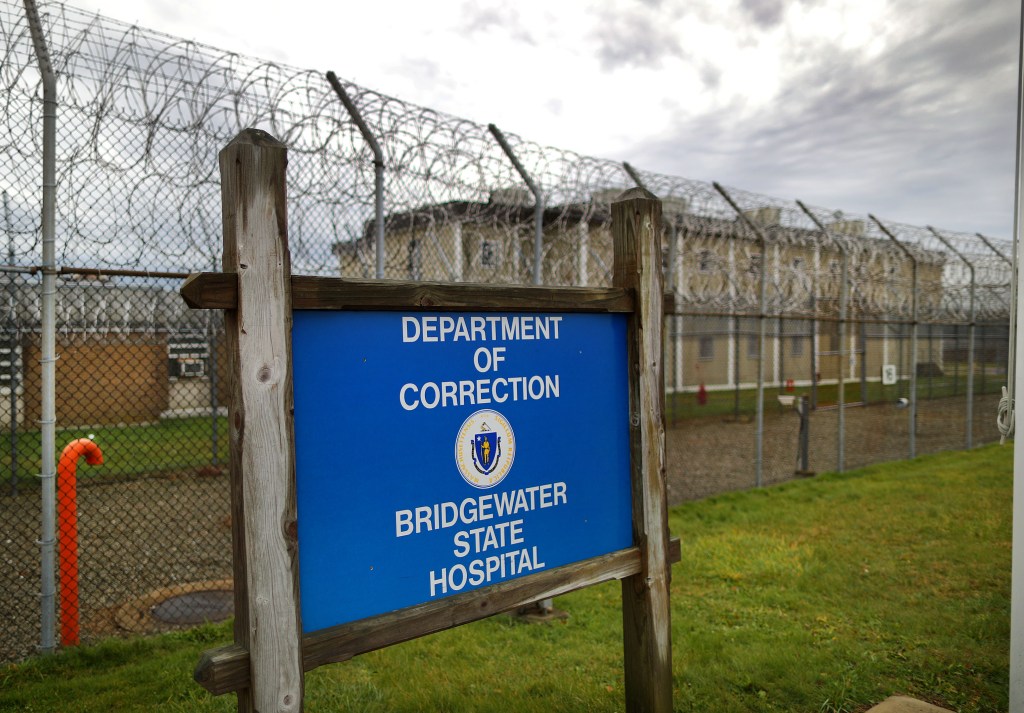
The report was mentioned in a March letter by the Joint Committee on the Judiciary, critiquing the Baker administration for its resistance to statutory requirements and policy objectives for criminal justice and police reform. Such policies include objectives to eliminate restrictive housing or solitary confinement by 2021.

The DOC published a response to the report later that month where it “disagrees with DLC’s allegations that the conditions of the physical plant is unsafe, that the DOC’s mold remediation work has been deficient, and that care of Persons Served is contrary to state law.”

In that letter, they state that $88,000 has been approved for air quality testing and asbestos and mold remediation and cited their decrease in reported seclusion and restraint. As for the involuntary chemical restraint, called an Emergency Treatment Order (ETO) in the response, use is not reported to the Commissioner under Wellpath policy if administered without physical restraint.

More prisons or no prisons? Plans move forward

Last year, the state’s Designer Selection Board published a notice for the study and design of a women’s prison. In the meeting agenda for last year, the last mention of this project was in March, mentioning that three finalists were selected for the design. The project has been met with resistance from the public. 

Families for Justice as Healing (JSH) has previously criticized the lack of transparency by the state in advertising bids for prison construction. In an article last year, FJH also critiqued an alternative to the public bid process known as the “house doctor” method used for the construction of courthouses.

“Division of Capital Asset Management and Maintenance (DCAMM) may have specifically solicited proposals from existing but substantively inapposite House Doctors in order to avoid further public scrutiny.”

Here, firms become pre-qualified to be “house doctors” and remain on call for projects. The firms then submit bids when projects are available, rather than going through the public bidding process.

Now, that same process is being used for the construction of prisons. The DCAMM did not respond in time for this publication on whether the “house doctors” will be used for the construction of the controversial women’s prison.

Featured

Vertical Farm Helps Feed Long Island

By Jhonatan Bonilla

Along the south shore of Patchogue, Long Island, in the back roads next to a boat yard, you can find a farm growing fresh basil year round for local businesses. This basil is grown indoors and is a product of the vertical hydroponic farm Urban Fields Agriculture.

The indoor farm focuses on greens and herbs. Basil is the key seller with sprouts being grown to order. Inside there are three, four-level stacks of basil at different stages of their growth and a smaller separate rack focused on the seedlings of the herb. 

“I was growing arugula for a while, mint, chives, stuff like that. But at the current scale that I’m at they’re just not worth it to grow,” Cory Mahony, owner of Urban Fields Agriculture, said. “So I’m focusing more on the specialty crop, the highly perishable basil, that goes bad really fast. Having a fresh supply in the winter time is invaluable to restaurants.”

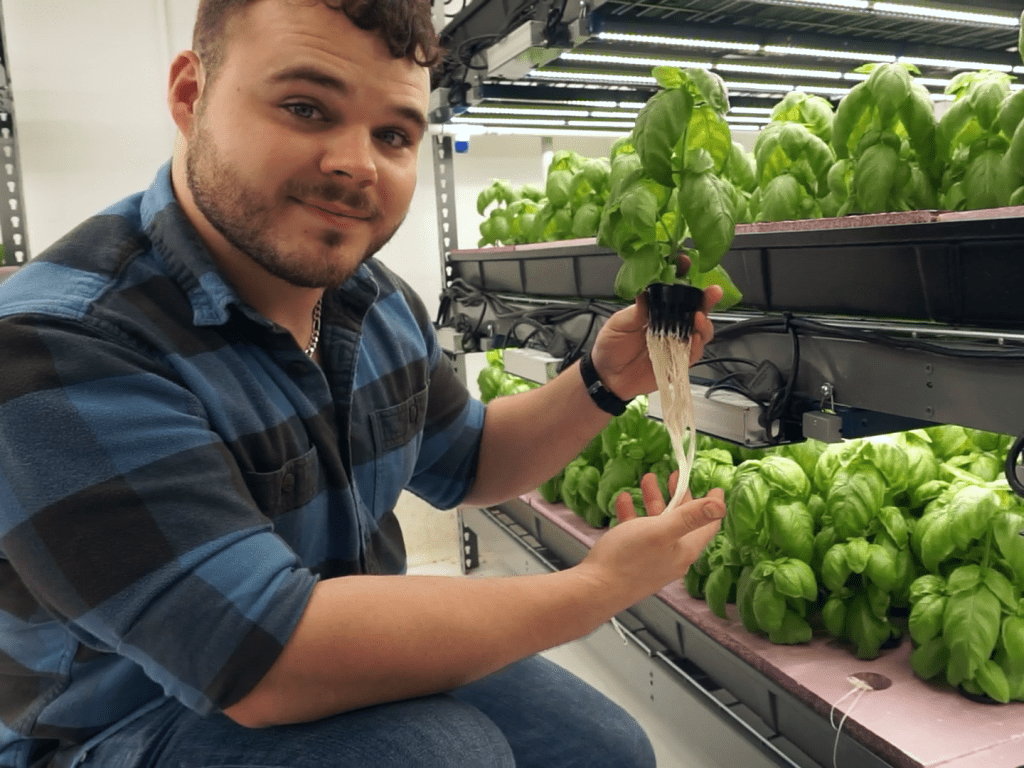
Cory Mahony, Owner of Urban Fields Agriculture, holding a basil plant.

The farm’s basil goes to local businesses such as Delfiore Pork Store, Donatina’s pizzeria, and the Great South Bar. What isn’t sold Mahony donates to the recently established non-profit Carroll’s Kitchen LI.

“He’s donated basil to us like every day since day one, 37 days ago,” Ryan Carroll, the founder of Carroll’s Kitchen, said.  “When I get basil here, he picks it and it’s been picked fifteen minutes and then it’s on a plate… It’s the freshest basil possible, you can’t compete with that.”

Above the methodically spaced plants are rows of LED lights to replace the sunlight that the plants would be missing.

“The roots grow down into a solution of water and dissolved nutrient powder that you can tailor and modify for the specific crop you’re growing so it gives it the optimal amount of nutrients and exactly what the plant needs,” Mahony said.“Using this method allows plants to grow about 50% faster.” 

Aside from shortening the harvest period, hydroponics has other benefits that it shares with aeroponics, another non-conventional method of farming.

“In around 1980, aeroponics came to grow because NASA wanted to farm on the moon or Mars,” Dr. Dickson Despommier, an emeritus professor of microbiology and public health at Columbia University, said. He wrote about the development of alternative farming methods in his book,“The Vertical Farm: feeding the world in the 21st Century,” in 2010. “The way you can conserve water maximally and still grow food is to use aeroponics. It uses 70% less water than hydroponics which uses 70% less water than outdoor farming… In many places where there is no water, for instance the Middle East, growing food hydroponically is a good idea.”

This sustainable way to farm was introduced to Stony Brook University in 2015 by the company Freight Farms, who installs small hydroponic farms that are built inside shipping containers. 

“In addition to different types of lettuces, we also grow herbs and radishes, managing their growth through live camera feeds and a smartphone app,” Angela M. Agnello, a director of marketing and communications at Stony Brook University said. “Each semester our student-run farm, with support from the Faculty Student Association and CulinArt, produces approximately 800 heads of bibb and chicory lettuces per week, which we serve to customers.”

Now that the students are no longer in class due to the COVID-19 pandemic, the farm is being operated by staff from FSA and CulinArt, which harvests the produce and supplies it to the dining halls. 

The closing of schools due to the pandemic is affecting this farm, but the closing of borders could also limit visiting farm workers from reaching farms here in the United States as travel restrictions have been implemented to slow the spread of the virus. In 2019, there were 204,801 H2-A, agriculture guest worker, visas issued. Of those, 8,100 came to New York last year. No data has been published by the Department of State and farm employers and associations are reporting mixed results.

Farms who still have a work force, whether vertical or horizontal, still face the danger of infection and must provide equipment and implement safety measures to reduce the spread. 

“Everyone social distances, wears masks, gloves and has their own vehicles,” Larry Perrine Partner and CEO of Channing Daughters vineyards said. The vineyard, which along with not being open for tasting, has also adapted by selling online or over the phone and either shipping or doing pick-up orders. 

Perrine says sales are down due to restaurants being closed.

This has had the same effect on Urban Fields Agriculture. “The average order size went down,” Mahony said, with some customers cutting their orders “roughly by half,” “but there’s been a shortage of fresh produce so I’ve gotten new customers.”

Mahony plans on expanding his three rack farm into seven, and hopes to expand further in the next two years.

The vertical farming market was valued at 2.23 billion dollars in 2018 and is expected to projected to reach 12.77 billion by 2026.

there’s been a shortage of fresh produce so I’ve gotten new customers.”

Mahony plans on expanding his three rack farm into seven, and hopes to expand further in the next two years.

The vertical farming market was valued at 2.23 billion dollars in 2018 and is expected to projected to reach 12.77 billion by 2026.

Sand Land Mine in Noyack Faces Regulation

Representatives of FPM Group, an engineering and environmental science consultancy firm,  presented a draft for legislation last month to regulate sand and gravel mines in East Hampton and protect the aquifers from the effects of mining.

The draft was introduced during a town board meeting on February 4, and discusses that mine operators must provide the town with plans to test how their work affects the groundwater. The plan proposes that the mine show detailed plans on how to recover exhausted mines.  

“Residents [are] asking us to support them and write letters of support, opposing the expansion,” Kimberly Shaw, Environmental Protection Director of East Hampton, said.

The firm specifically mentioned a study conducted at the Sand Land mine in Noyac and how, as a result of composting, the aquifer has shown an increase of manganese, iron, pesticides, and other toxins.

The aquifers are an underground layer of water and are crucial to Long Island because they are the main source of water for drinking and irrigation. Sand Land mine sits deep in a groundwater recharge zone of the aquifer, making it even more dangerous when pollutants seep in.

The results of the study done at the Sand Land, mine operated by Wainscott Sand and Gravel, is worrying residents near East Hampton Village because mining not only adds pollutants to the ground but also weakens filtration of its aquifers.

“The most concerning part is we know nothing about it,” Brian Saville, a Sag Harbor resident, said. Saville and his family have owned a house in the Hamptons area for generations and the fact that they are just learning about the mine’s operation now is worrisome.

The mine is used to excavate sand and gravel. Sand is in high demand because it is a key ingredient in the creation of concrete. The demand for concrete is predicted to increase in 2020, mostly due to building construction, according to Concrete Construction.   

“Nobody really likes us,” Janine Astorr, office manager at Wainscott Sand and Gravel, said. “We’re in litigation right now.” 

The mine is not going to be shut down and that they are not the only ones in the area doing things like this, Astorr said. Her boss and the owner John Tintle did not care to comment after being reached out to multiple times.

“Once you dig that big deep hole, then its the other activities that you have going on site [like] composting and fuel storage” Shaw said. “They are accepting debris and just filling the holes.”

The mine previously applied for expansion but was denied. Now residents are seeking reclamation of the land as a whole. Once the mines are used to their capacity the area should be reclaimed by the town so harm cannot be done to the nearby land and underground aquifer, according to Stephanie Davis, head of FPM’s Hydrology Department.

The legislation for reclamation has just been drafted and proposed, but if it is passed mines such as Sand and Land will have to look elsewhere to keep mining.

Design a site like this with WordPress.com
Get started